Fri 6:45 PM
The fairest schedule real life allows. It remembers every request it could not meet.
Fields close. Coaches run two teams. Siblings play back to back. Every coach has asked for a kickoff. The scheduler holds all of it at once, builds each cycle from the standings, and when it cannot give a coach what they asked for, that coach counts for more the next time.
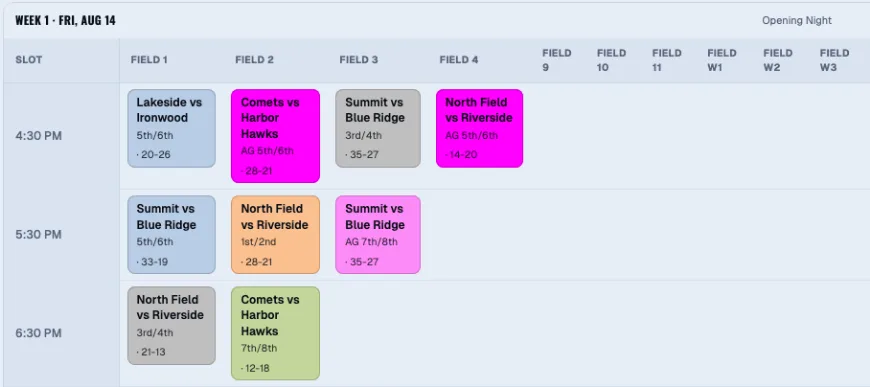
Every coach asked. Release the cycle.
Each head coach marks their game times firm, strong, or flexible, and one still has not answered. The cycle is built around the requests that are in. No family can see it yet. Press the button and they can.
Move a game. See what it breaks.
This week is released, and the city just closed a field. Pick the game and a new place for it: the same checks that built the schedule name what the move would break before anything is saved. Then send the change to the families it reaches, and nobody else.
The city closed Field 1 until 6:00 PM. One game has to move.
Pick a game, then pick where it goes.
What this week is holding
- Hard violations
- 1
- Soft violations
- 0
- Field 1 is closed at 5:30 PMBroken
- Coach Alvarez has Hawks and Rockets: never at one kickoffKept
- K-1 kicks off at 5:30 PM or 6:45 PMKept
- Comets: not before 6:45 PM (picture day)Kept
- North asked for 6:45 PM (firm)Kept
- Comets asked for 5:30 PM or 6:45 PM (strong)Kept
- Riverside asked for 6:45 PM or 8:00 PM (strong)Kept
- Ridge asked for 5:30 PM or 8:00 PM (flexible)Kept
- The Okafor family plays for North and Storm: one campusKept
Fair is an order of promises.
A schedule is a set of promises that cannot all be kept at once. The scheduler is told which ones come first and holds to that order on every cycle and on every game you move by hand. This is the order Advantage Flag League runs under. Yours may rank them differently, and we set that up with you.
Never broken
- Two games on one field at one time.
- A team, or a coach with two teams, in two places at once.
- A game on a closed field, or on a field its division does not use.
- A kickoff outside a division's hours, or one a team cannot make that week.
- A family with players on two teams left with no time between their games.
- A team with no game in a week, or the same opponent twice in a cycle.
A schedule that breaks one is flagged as blocked, and is never accepted without you saying so.
Then, in this order
- The kickoff a coach asked for.Firm before strong, strong before flexible.
- A family's two games on one campus.Nobody drives across the street between kickoffs.
- The shortest wait between those two games.Inside the break the family was promised.
- Nobody who asked is missed every week.Going a whole cycle without the kickoff you asked for costs extra.
The higher a promise sits, the more it takes to give it up.
And it remembers
When a cycle cannot give a coach the kickoff they asked for, that is written down. In the next cycle their request counts for more, in proportion to how often it has been missed so far in the season.
| Missed so far | Next cycle, the request counts |
|---|---|
| None of them | the same as before |
| One week in three | 1.5 times |
| Two weeks in three | 2 times |
| Every one | 2.5 times |
- It stops at 2.5 times, so a flexible request never passes a strong one, and a strong one never passes a firm one.
- A coach who got everything they asked for is never marked down for it.
- A request for a kickoff the division does not play earns nothing. That one is flagged for you, with the kickoffs to offer instead.
You see it too: every team's request history sits beside its request, cycle by cycle.
From fields to final scores
Fully custom cycle rules
Set your own cycle length and reseed schedule, plus the fields and game times you have each week, including kindergarten sessions. The scheduler builds each cycle from them and your league rules, puts honoring coach requests ahead of every other preference, and pairs opponents whose requested times overlap.
The conflicts nobody tracks by hand
A coach with two teams never has two games at once. A family with players on two teams is kept on one campus with time to walk between games. Each division has its own kickoff band and its own fields.
Coach requests, collected in the app
While the request window is open, head coaches send their preferred kickoff times in the app and mark each request firm, strong, or flexible. A date-specific conflict, like picture day, becomes a per-week rule a league admin adds. A request no schedule can meet is flagged with the kickoffs to offer instead, and a coach who missed out in one cycle counts for more in the next, up to two and a half times.
Solved, not guessed
Fall 2026's first cycle was 159 games: 53 a week on 11 fields, with two open cells to spare. It was solved in about three seconds. No language model places a game, a validator checks every rule, and the same inputs give the same schedule.
Brackets reseeded from standings
Before each new cycle, brackets are cut from the current standings, so teams play opponents at their level, with the higher seed at home. The run will not start until every game in the cycle before has a score.
Release a cycle, then change it safely
Release a cycle when it is ready. Game reminders go out to families for you, and families and coaches can subscribe to their team's schedule in their own calendar app. Move a game afterward and the same validator names what the move breaks before you confirm it; schedule-change notices go only to the families it reaches. Playoff games join the feed once they are published.
From the field to the public site
Field crew enter final scores on their phones right after each game and attach a photo of the scorecard. The public schedule, scores, and W-L-T standings with point differential update from them, and each team has a shareable public team page. Your league can also publish weighted points standings when it chooses; standings can be sorted by them, and playoff seeding follows them.
Championship Night
Seeds freeze from the standings and the night's grid of fields and times is published. A public Championship Night page updates as crew enter finals, qualifying families and coaches get an email with their seed, first game, field, and time, and winners advance right away. The field grid, the line-up cards, and a one-page schedule for parents print from the same data.
From a cycle to the public standings.
Build the cycle
Your fields, time slots, and league rules go in with the coach requests and any per-week rules an admin added. The run comes back as a full cycle you can accept or send back.
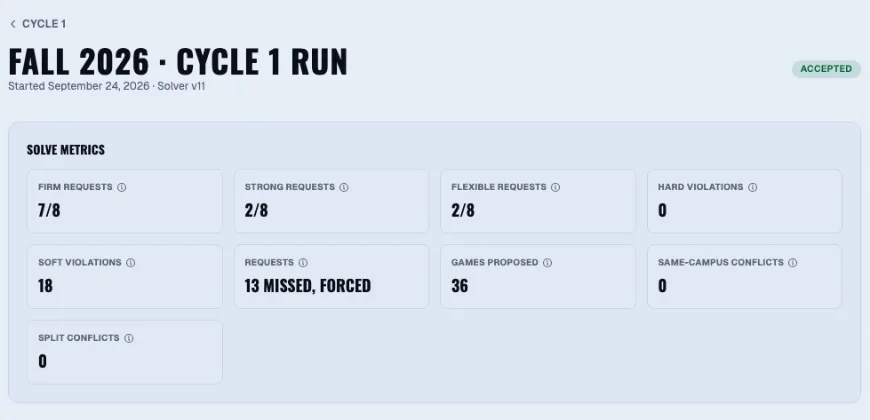
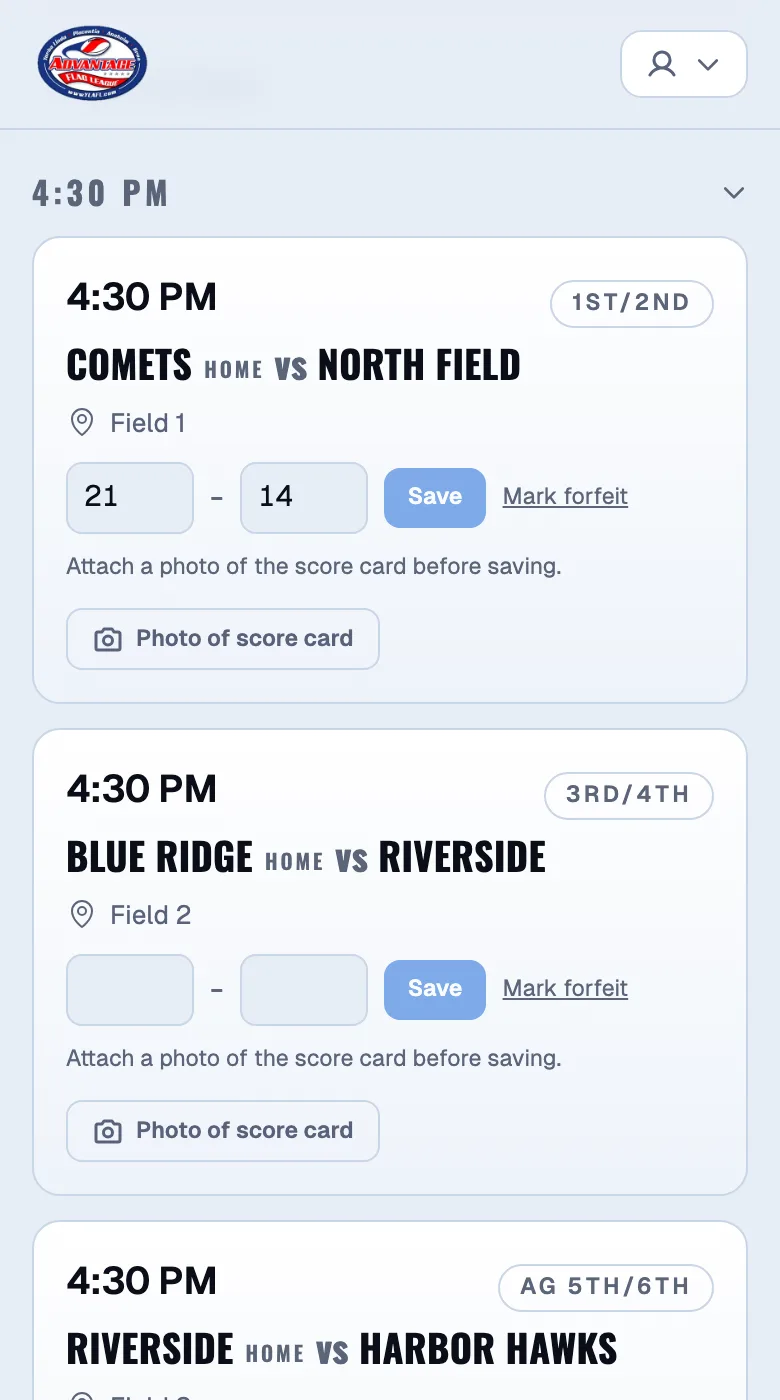
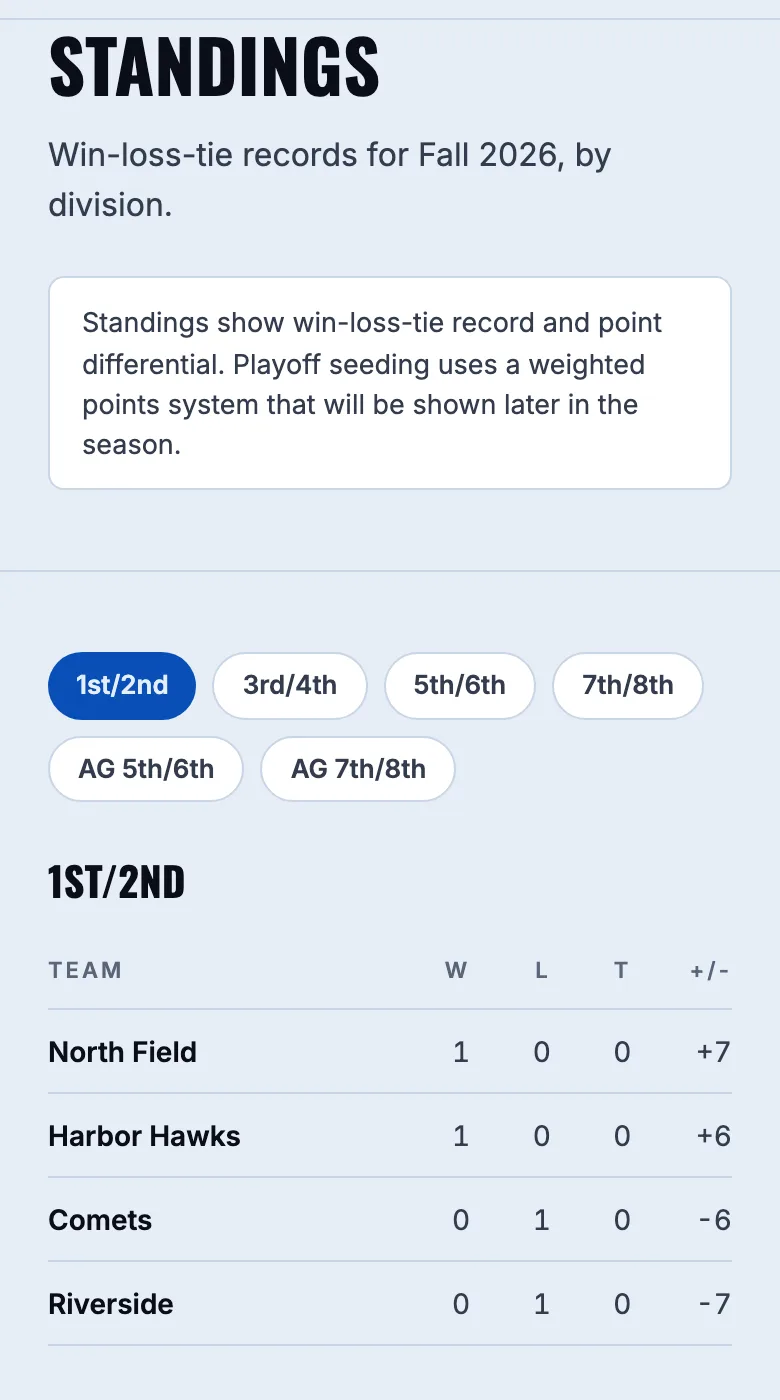
One final. Three new weeks.
The next cycle cannot be built until every game in this one has a score. You are the crew member holding the last one. Enter it: the standings reorder, the next cycle seeds itself from them, and it is built around the coaches' requests before the teams have left the field.
Publish the night. Watch it run.
The seeds are frozen from the standings and the bracket is laid out, but nothing is public. Press the button: the public Championship Night page goes live, qualifying families and coaches get their seed, first game, field, and time, and each final a crew member enters moves its winner on.
Questions operators ask.
How often do brackets change?
That's set by your cycle rules. Our founding league runs three cycles of three weeks, with brackets reseeded from the standings before each new cycle.
Who enters scores?
Your field crew, from their phones, right after each game. They can attach a photo of the scorecard.
Where do families see the schedule and standings?
On your league's public site, which shows the schedule, scores, and W-L-T standings with point differential.
Can coaches ask for specific game times?
Yes. While the request window is open, head coaches send their preferred kickoff times in the app, marked firm, strong, or flexible, and the scheduler honors requests ahead of every other preference. In Fall 2026, head coaches for 71 teams sent their game-time requests through the app. A request the schedule cannot meet is remembered, and that coach counts for more in the next cycle.
What happens when a game has to move after the schedule is out?
Move it on the board. Before anything is saved, the validator that checked the schedule names what the move would break: a coach with two games at once, a kickoff a team cannot play, a request that would be missed. Confirmed changes collect in a banner, and one press emails only the families whose game moved, with the old time struck through beside the new one.
Is the schedule made by AI?
No. Placement is solved, not guessed: no language model places a game. Every schedule is checked against the hard rules by a validator, and the same inputs always give the same schedule.
How does Championship Night work?
Seeds freeze from the standings, and you publish the night's grid of fields and times. Qualifying families and coaches get an email with their seed, first game, field, and time. A public Championship Night page updates as crew enter finals, and winners advance to their next game right away.
Stop rebuilding the machine every season.
See the platform with your own divisions and pricing. We'll walk through a real season setup in 30 minutes.